
E-Bikes: A Boomer's Guide
What’s all the fuss about E Bikes? You see them everywhere, even in high end bike shops that sell ultra-sophisticated feather-light road racers that can cost $10,000 and up.
My first reaction is to say, “Have our sedentary ways gotten to the point that when we do finally get our butts off the couch, we can’t even pedal a bike without the aid of a motor?”
We know that cycling is an excellent, low-impact alternative to jogging that can be enjoyed by virtually everyone. In my lifetime, I have witnessed cycling evolve from an activity reserved basically for kids into a hi-tech sport.
Of course, as our favourite octogenarian rock star Sir Mick says, time waits for no one. The challenge of steep climbs and headwinds have lost a lot of their romance. Plus, there are new realities to face, like climate change, traffic, limited parking, the high cost of fuel and the cost of owning a car. And let’s not discount the impact of technology: incredible advances in lightweight lithium batteries and motors have transformed e-bikes into sleek riding machines that are fun and safe to ride.
Might as well face it. The e-bike has come of age.
So if you’re in the market for one, the first thing to understand is that it is not another kind of scooter. You do need to pedal. The motor acts like a power assist that can be adjusted according to the fitness level of the rider and the conditions. There’s also a speed limit: above 25 km/h the motor cuts out and you’re pedalling under your own steam.
Powertrain
- E-bikes are equipped with electric motors located either in the hub of the wheel (hub motor) or near the pedals (mid-drive motor).
- Hub-mounted motors are generally offered on lower-end models. Power delivery is not as smooth as mid-drive.
- Mid-drive motors are used on higher-end models. Since the motor is directly connected with the bike’s power train, power delivery is smoother and better controlled.
- Motors vary in power output, ranging from 250 watts to 750 watts or more.
- The motor receives power from a battery, usually lithium-ion, measured in watt-hours (Wh). Higher-capacity batteries generally provide longer range.
Range
Multiple factors affect the range an e-bike can travel before recharging: battery capacity, motor power, terrain, rider weight, and assist level. On average, e-bikes can cover distances ranging from 20 to over 100 miles on a single charge.
Types
- Commuter e-bikes — designed for urban commuting, with a more upright riding position, integrated lights, racks, and fenders.
- Mountain e-bikes (e-MTBs) — built to navigate off-road trails, with suspension, knobby tires, and rugged frames.
- Folding e-bikes — compact and portable, convenient for city dwellers or commuters with limited storage space.
- Cargo e-bikes — designed to carry heavy loads, with sturdy frames, long wheelbases, and cargo racks or boxes.
- Road e-bikes — similar to traditional road bikes, built for speed and efficiency on paved roads.
Certification
Currently, you don’t need a driver’s licence to operate an e-bike in Canada, but the government has stepped in due to safety concerns. Certification standard UL2829 is voluntary for now, and many manufacturers have not implemented it because of the additional cost. Comparing the price with the brands that do comply is something to keep in mind when shopping.
Cost
E-bike prices vary widely depending on brand, quality, features, and type. Entry-level e-bikes can start at around $1,000, while high-end models can exceed $10,000. Mid-range e-bikes typically range from $1,500 to $5,000.
Cons
- Replacement lithium batteries are expensive and should be removed as a precaution against theft if you are leaving your bike in a public place.
- Cheaper models can be prone to breaking down and hence unsafe.
- Pricey compared to a conventional bike.
- Less of an exercise/health dividend.
- Heavier than a conventional bike.
Pros
- Cost-effective alternative to commuting with a car.
- Perfect for navigating the urban environment.
- Green transportation.
- Carry all your stuff for work or groceries and get to the office without working up a sweat.
- Depending on the level of assist, it can be a good form of exercise.
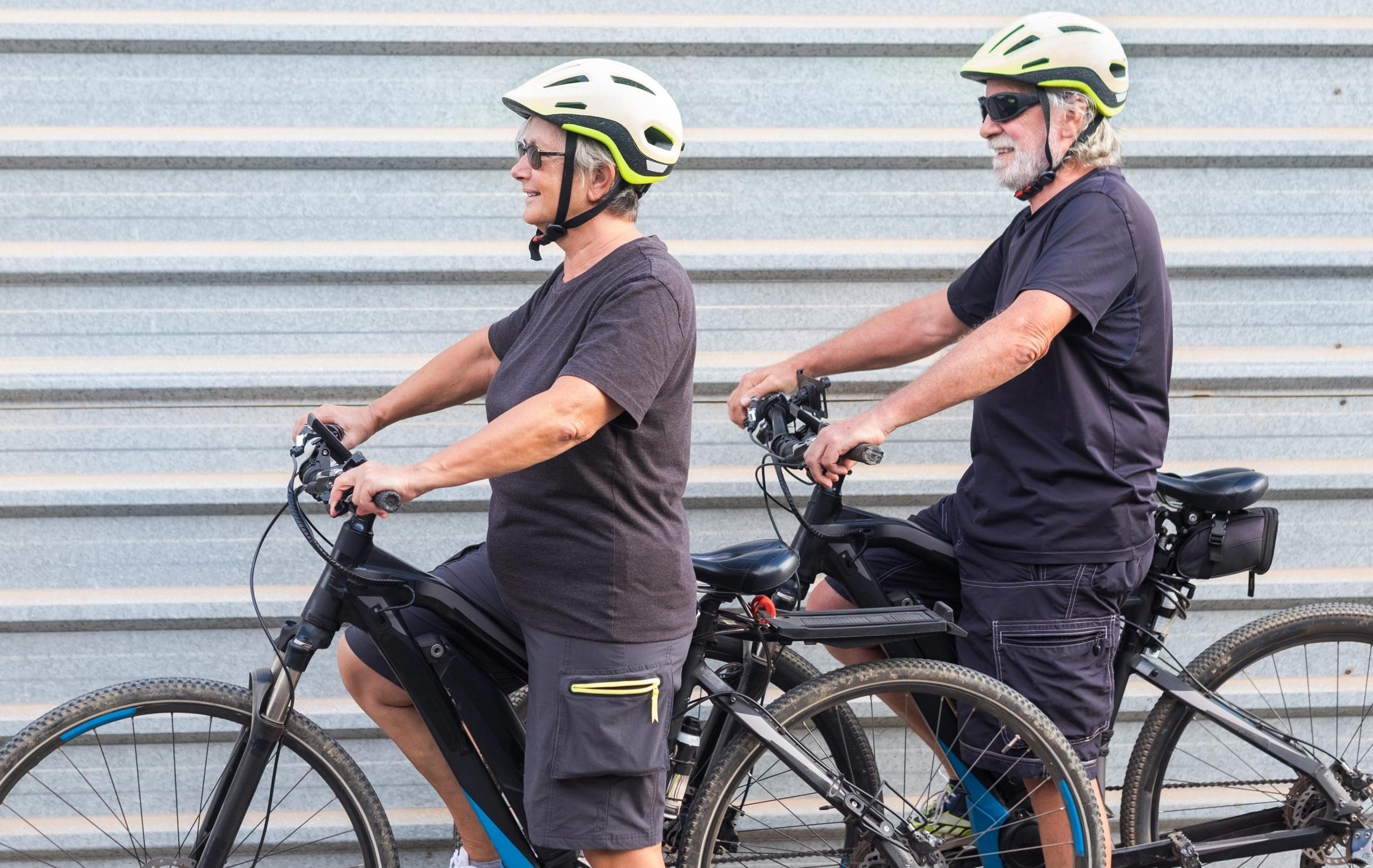
In the final analysis, e-bikes are just plain fun and it would appear they are here to stay. For RV enthusiasts, who love exploring and the great outdoors, they’re a fantastic mode of transportation for long rides on those mountain and forest trails.